A hidden toxin is sitting inside your brain right now, quietly shutting your Third Eye
And the 5,000-year-old yogi fruit thousands of readers are using to dissolve it and awaken the Third Eye, without a guru, without a retreat, and without another year of "trying so long to meditate but nothing's happening."


Before this page opens, every reader answers one question: what are you looking for right now? This week 2,791 people answered, and 1,408 of them wrote why.
Most had assumed the fog, the blank mornings and the quiet gut feeling were simply part of getting older.
The yogis had a name for what they were missing: the Third Eye, the seat of inner sight, where the intuition and the dreams come from. And they had a fruit they took to awaken it. First, though, what is closing it.
"I am tired all the time. I have missed seeing dreams. I feel the need to get rid of the fog in my brain. I am 61 years old." (Belgium)
"I used to see things before. I cannot see now." (United States)
"Get rid of the brain fog and feel alive again." (United States)
"I want my life back." (United States)
It turns out their "bad luck" wasn't random at all.
And, as a growing body of research suggests, they are not alone.
The signs most readers learn to ignore
Do any of these sound familiar?
- "So tired of being tired and sluggish in mind and body."
- "I leave the bedroom to the kitchen and I forget what it is that I wanted."
- "I can't remember the last time I had or remembered a dream."
- "I used to see things before. I cannot see now."
- "I can't find a quiet place within. It's noise there too."
- "Always 100 thoughts and don't stick to the plan."
- "I just want to feel like myself."
Most readers recognised at least three. They blamed age, stress or weak faith, and tried a new practice, a new course, another cleanse, each aimed at a single symptom.
But what if all of those traced back to a single hidden source?
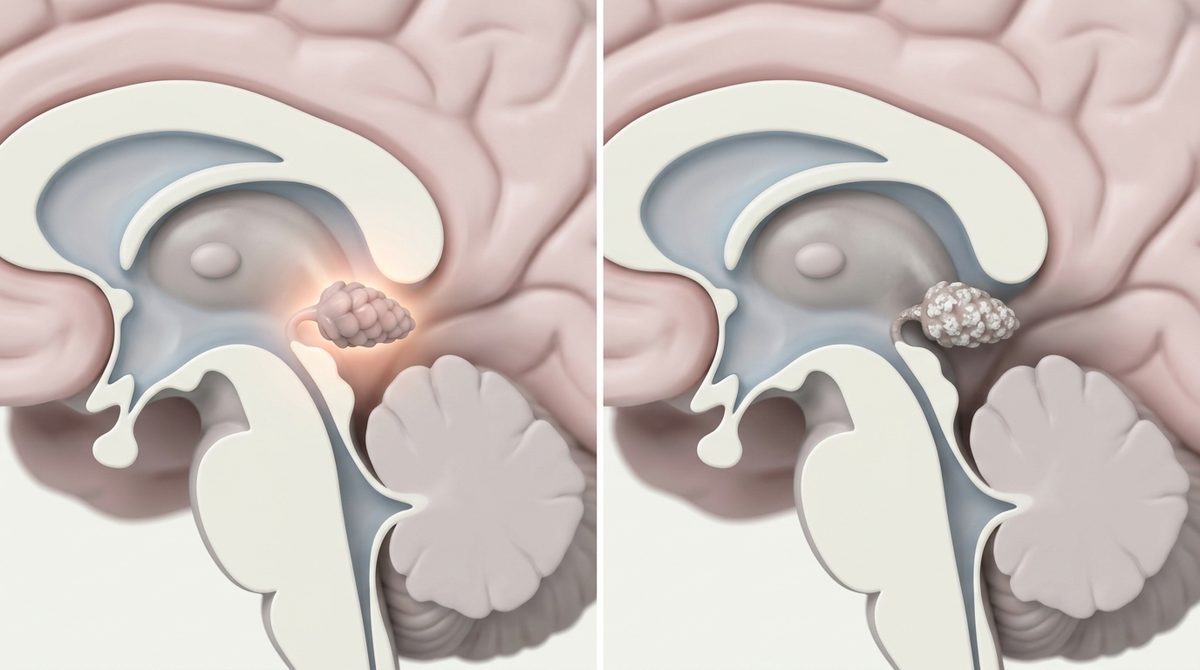
The silent shell inside your head
If you recognised two or more of those signs, here's what may actually be going on.
At the center of your brain sits a gland the size of a grain of rice: the pineal gland. The seat of the Third Eye. It runs your sleep, your dreams, your melatonin, and the quiet knowing most people call intuition.
In 1997, Dr. Jennifer Luke at the University of Surrey found that this gland collects more fluoride than any other soft tissue in the body. It gets in through the tap water, the toothpaste, and the processed food made with the same water. By 40, most pineal glands are coated in a calcium fluoride shell. On a brain scan it shows up as a bright white spot.
What the shell actually does
It dims the signal. The dreams go quiet first. Then the intuition, the gut feeling you used to trust. Then the clear head, which is why you walk into the kitchen and forget. And slowly, the sense of being yourself.
All at once. Every day it stays.
"I don't particularly appreciate the government having any kind of control of my mind or body or spirit, for that matter." (United States)
Key takeaway: the signs readers blame on age, stress or weak faith share a single, identifiable cause. And that cause is reversible.

Why nothing you tried could reach it
The unsettling part isn't that the shell exists.
It's how well it protects itself.
The calcium problem
Calcium fluoride barely dissolves in water. Once it sets on the gland it does not wash out with sleep, a cleaner diet, or a longer sit. Think of the scale inside a kettle. Now imagine it around the antenna of your brain. You can scrub all day and never reach the problem underneath.
Key takeaway: your practice didn't fail because it was weak. It failed because it couldn't reach the shell.
In the quiz answers and under our Facebook posts, the same attempts come up again and again. Six patterns, in the readers' own words:
- Meditating harder, for years."I'm trying so long to meditate but nothing's happening." · "I have tried for over 5 years now. Read books and listened to frequencies. Nothing works. Why not?"Meditation calms the mind. It cannot dissolve a mineral.
- Cutting the fluoride out."I haven't drunk chlorinated or fluoridated water in over 40 years. Haven't noticed anything." · "I never remember dreams, and have been doing fluoride-free water since birth."Stopping the source stops the new layers. It does not touch the shell already there.
- The clean-living stack."No fluoride, no processed meat, no sugars, spring water, listening to frequency 369. Nothing is working. No 3rd eye." · "Grey salt crystals and spring water in a glass bowl."All of it is good for you. None of it reaches the gland.
- Fasting and detoxes."I fast 12 to 24 hours. How do I do it? I want my 3rd eye to be awakened." · "Fasting is the first step, then detoxing heavy metal."A fast empties the gut. Calcium fluoride does not leave with it.
- Praying, doing everything."I have been praying, doing everything I can, and nothing seems to work." · "I have been on the cusp of opening it for years and just can't seem to break through."Prayer reaches the spirit. It does not reach a calcium shell.
- The hundred activators."Everyone has a suggestion on how to decalcify the pineal gland. There's like 100 different things out there. How do you know which one works?" · "Nothing. Been on it for 3 weeks. Nothing. Another $200 down the drain."Most never cross the blood brain barrier. The shell never sees them.
The real problem isn't your Third Eye. It's the wall around it.

A 5,000-year-old fruit with an uncomfortable track record
This is where the story takes a turn.
For 5,000 years, Himalayan monks and yogis have taken one fruit before meditation and before sleep, for one reason: to awaken the Third Eye. Haritaki. In the yogic tradition it is the fruit of the ajna, the eye of inner sight, taken to open it and keep it open. The Charaka Samhita, written around 600 BCE, calls it the King of Medicines. Tibetan monks still take it before meditation for the sight, and before bed for the dreams.
The monks did not know the word fluoride. They knew the fruit cleared the head, brought the dreams back, and made the sitting deeper.
The 8-week protocol
In a placebo-controlled study, adults took Haritaki daily for eight weeks. No other changes.
At eight weeks: a 46.1% reduction in perceived stress markers. A 33% improvement in cognitive focus scores versus placebo. A 31.4% improvement in sleep quality and calm.
Not a mood. Measured.
Key takeaway: the fruit the monks chose by experience is the one the studies keep confirming.
"One may eat Haritaki without apprehension, as a son trusts his mother."
Here's the part almost no one talks about.
The Haritaki in the study wasn't the powder you find online.
The active compound is chebulinic acid. The blood brain barrier blocks 98% of compounds. This one gets through, binds to the calcium fluoride, and breaks it apart. That process is called chelation.
Why one step is rarely enough
Dissolving the shell is only half the story.
If what comes off the gland isn't escorted out of the body, some readers feel foggier before they feel clearer. That's why the fruit works as a two-step:
Step 1: dissolve
Crosses the blood brain barrier, binds to the calcium fluoride and breaks it down. This is the demolition crew.
Step 2: flush
Over 200 tannins protect the neural tissue while the shell comes off. Gallic and ellagic acid carry what is released out of the body. This is the cleanup crew.
Used together, nightly, they give the body something it can actually finish: dissolve, then flush. Week by week the shell thins.
"After a week my intuition skyrocketed and it's as if I have an extra sensitive gut feeling."
What 1,408 readers wrote they want back
"Get rid of the brain fog and feel alive again."
"Heal my body."
"Liberate myself from toxic, anti-productive habits."
"Discover the truth."
"Raise my vibration and have my vivid dreams back."
"Focus more and succeed at life."
"I want to have clarity of thought and intuition back."
"I want to be fully aware of myself and my entire life."
"Become more present and understanding."
"Quit habits that halt my ability to grow and to please my creator."
"I want to heal my body and reunite my family."
"Just let me see things again."
Twelve sentences, one gland underneath them all.
How an independent maker put the whole fruit in one capsule
One of the more interesting follow-ups to the research came not from a pharmaceutical company.
It came from a small independent maker called Peptiques.
Their team spent two years finding a source in the Himalayan foothills at 1,500 meters, where the fruit is hand-harvested once a year, and cold-process it below 40°C so the chebulinic acid stays alive. They sell it as Haritaki Third Eye: sixty capsules, one ingredient.
It's not a magic pill. It's not a shortcut past your own practice.
But it is the first off-the-shelf product we've come across that actually mirrors what the monks took, rather than the lowland powder with the active compound cooked out.
What sets it apart
Third-party tested. Every batch, by Eurofins. Most brands quietly skip this.
One ingredient. Whole fruit, cold-processed, no fillers and no proprietary blends.
Used by 4,400+ surveyed customers. 89% take it daily and 83% report better energy and focus, with a 90-day refund window, no questions asked.

What readers are reporting
"It works. My dreams are unreal now. I feel more alive and awake."
"Been taking Haritaki for a couple weeks now and this morning I woke up feeling really connected and clear to my spiritual journey, and my intuition feels very much ONLINE now."
"I'm in my 4th month of taking this. My dreams are much more vivid than before, and I can remember most of them. My intuition is better... I am following through with a couple of tasks that I would ordinarily have let slide."
One quick word on what to expect. The first week is quiet housecleaning, from the gut up. Around night three some readers notice a light pressure between the eyebrows. That is the gland reactivating, not a problem. Sleep deepens first. The dreams follow, faint, then in color. Two capsules a day: one in the morning on an empty stomach, one before bed, with water.
Left alone, however, the trajectory is the opposite. Every night the shell stays:
- The dreams stay dark"I don't remember any of my dreams and I'm not even sure I do dream."
- The fog compounds, week on week"I forget most things."
- The intuition stays quiet"I used to see things before. I cannot see now."
- The coating thickens with every glass of tap water"I want to know how to clear the cement from my 3rd eye."
The contrast, on the other side, is what readers describe as the real surprise: mornings that aren't blank, a gut feeling you can trust again, steady energy into the evening, and the kind of clear head that makes you realise how foggy you had been operating.
It's time to clear the shell
"I am 78 years old. I want to see the world and where it is going." (Britain)
"I want this so I can actually get back what's mine." (United States)
"I want to heal my body and reunite my family." (United States)
Look, that coating on your gland isn't going anywhere on its own. It has a good thing going: a fresh layer with every glass of water, decades of build-up, and a body that has stopped noticing. You can keep meditating around it. Or you can dissolve it, and let your dreams tell you it's working.
The yogis were not being poetic. The Third Eye is a gland. The gland has a shell. The fruit they chose dissolves it. When it is clear, everything shifts: the dreams come back first, then the intuition, then the clear head, then the sense of being yourself. That is what awakening the Third Eye has always meant.
Peptiques sells direct, which keeps the price honest (Buy 2 Get 1 Free works out to $19.99 PER POUCH instead of $29.99, with free shipping), and ships from the US in about two days. We mention this because, for an advertorial, the bar should be: would we recommend it to a relative? On this one, we would.
Try Haritaki Third Eye for 90 days. If your dreams, your clarity, your memory or your energy don't change, you get every dollar back. No questions, no calls.
References
Where the figures and claims in this article come from. We've kept the list short on purpose: these are the studies we leaned on most.
- Luke, J. (2001). Fluoride deposition in the aged human pineal gland. Caries Research, 35(2), 125-128. (University of Surrey, 1997 doctoral research.)
- Choi, A. L., et al. (2012). Developmental fluoride neurotoxicity: a systematic review and meta-analysis. Environmental Health Perspectives, 120(10). Harvard School of Public Health.
- Sharma, P., et al. Chebulinic acid and the constituents of Terminalia chebula: pharmacology and blood-brain barrier permeability. Journal of Ethnopharmacology.
- An 8-week placebo-controlled study of Terminalia chebula on perceived stress, cognitive focus and sleep quality (46.1%, 33%, 31.4%).
- Charaka Samhita (c. 600 BCE), on Haritaki as the King of Medicines.
Reader comments
6 comments